

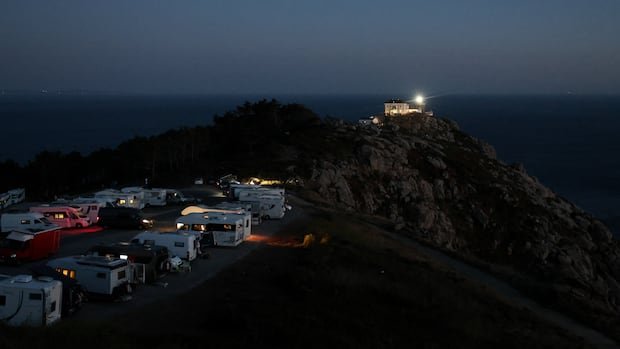

Hundreds of thousands of visitors have flocked to Spain in anticipation of witnessing the solar eclipse happening this Wednesday. However, the event coincides with high temperatures and an increased wildfire risk in Spain, causing concern for authorities aiming to prevent any lasting fire damage from the surge in astrotourism.
According to Virginia Barcones, the secretary general for civil protection and emergencies at Spain’s Interior Ministry, the country has faced a challenging summer marked by significant forest fires. To avoid any potential ignition sources, authorities are implementing restrictions on activities that could spark fires.
A heatwave has gripped much of Europe since May, exacerbating Spain’s ongoing wildfire season. Reportedly, approximately 603,000 acres of land have been scorched in about 400 fires this year, as per the European Forest Fire Information System.
To safeguard against additional fires, authorities are mobilizing 35,000 officers to monitor large outdoor gatherings during the eclipse, aiming to detect and prevent any potential fire incidents.
Spain is set to offer a prime location for viewing the solar eclipse, with the path of totality spanning 200 kilometers and crossing several countries, including northern Russia, eastern Greenland, western Iceland, and parts of Spain. Only individuals within this path will witness the moon completely obscuring the sun, while others, like in Canada, will experience a partial eclipse.
Notably, mainland Spain will witness a total solar eclipse for the first time in 120 years, sparking a surge in travel interest. Special measures have been put in place by the Ministry of the Interior to manage the expected large crowds, leading to a significant uptick in lodging searches along the eclipse’s path.
Authorities have designated 660 official viewing locations to accommodate the anticipated influx of over 440,000 people, with an estimated 1.5 million individuals expected to be on the move to reach these sites. Tourists are being cautioned against using barbecues and entering dry, fire-prone areas.
The economic impact study by the Ministry of Economy, Trade, and Business forecasts that the eclipse will contribute over 347 million euros to Spain’s economy.
Despite the heatwave and wildfire concerns, eclipse enthusiasts remain undeterred, drawn to the extraordinary spectacle of nature. The eclipse is anticipated to provide a unique experience, with a temporary drop in temperature and the appearance of stars and planets during the day.
As the eclipse fever continues, travelers are eagerly awaiting the event, with future eclipses also generating interest in astrotourism. The upcoming solar eclipses in the next few years are expected to attract more visitors to Spain, with the 2027 eclipse projected to traverse southern Spain before moving towards North Africa and the Middle East.