

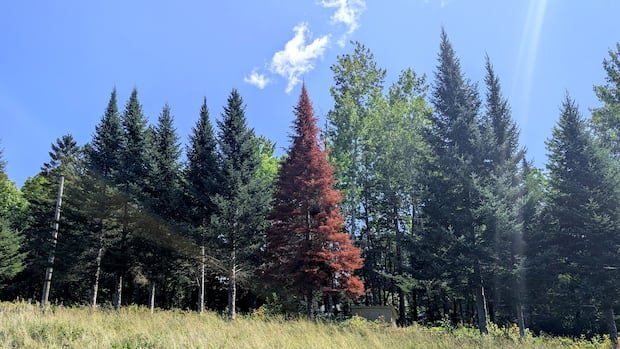

Balsam fir trees in New Brunswick are displaying a concerning trend of turning red and perishing following the severe drought experienced last summer. This worrying development has raised alarms about the fate of these iconic provincial trees. Forestry expert Prof. Anthony Taylor from the University of New Brunswick has been closely monitoring reports from woodlot owners and witnessing the distressing effects firsthand. The vibrant evergreens, often sought after for their use as Christmas trees, are gradually transitioning to a red, desiccated state before succumbing to mortality.
Prof. Taylor, who has extensively studied the impact of climate change on New Brunswick’s forests, notes that the current scenario mirrors previous instances observed after periods of hot, arid weather. He emphasizes that the warm, dry conditions of the recent drought have significantly hindered the balsam fir trees’ growth potential. The trees halt the crucial photosynthesis process prematurely in response to the drought stress, impeding their ability to generate essential energy reserves required for sustaining basic metabolic functions and producing defense mechanisms.
The shallow root system of balsam firs exacerbates their struggle to access water during prolonged dry spells. Peter McKeil, a woodlot owner in Burtt’s Corner, noticed the distressing transformation of his fir trees starting in June, with the lower branches progressively turning red. The ongoing die-off, marked by the appearance of new red patches daily, indicates that the situation is far from resolved. McKeil estimates a loss of approximately 100 trees thus far and has altered his harvesting practices to salvage value from the remaining trees before further losses occur.
Despite salvaging some lumber from the deceased trees, McKeil expresses concerns about the future viability of the species, particularly in southern New Brunswick, attributing the predicament to worsening climate change effects. He foresees a bleak outlook, suggesting that balsam firs may be destined for disappearance or adaptation to survive in altered climates. Prof. Taylor underscores the significance of the current visible impacts on the trees as a poignant indicator of the broader climate crisis. He urges for urgent climate action, emphasizing the need to transition away from fossil fuels and adopt sustainable forest management practices to mitigate the escalating environmental challenges.