

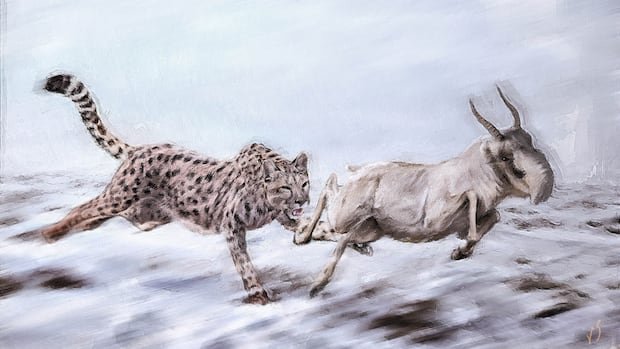

Initially, bones discovered in the Bluefish Caves and a mining site in northern Yukon were thought to belong to an ice-age puma or cougar. However, DNA analysis conducted by the University of California revealed a different story.
The examination was carried out by Molly Cassatt-Johnstone, a lab technician fresh out of her undergraduate studies. These Yukon bones marked some of her earliest samples, and upon analyzing them, she was surprised to find they did not resemble pumas at all.
Grant Zazula, a Yukon paleontologist, vividly recalls his astonishment upon receiving a message one evening informing him that the supposed cougars were actually cheetahs.
Zazula reflected on the advancements in ancient DNA analysis, noting that twenty-five years ago, such techniques were considered almost like science fiction, reminiscent of Jurassic Park. Nowadays, genetic analysis of permafrost-preserved bones from the Yukon has become a routine practice.
Cassatt-Johnstone became the first to identify a Yukon Miracinonyx, also known as the extinct American cheetah. She is now the primary author of a research paper published in Current Biology, which provides new insights into the ice-age cat’s diet and habitat.
‘A Fascinating Mystery Unraveled’
For years, researchers believed the American cheetah, resembling today’s agile cheetahs with their long limbs and slender physique, would have evolved to pursue pronghorns across grassy plains. The discovery of these creatures in the Arctic tundra baffled paleontologists.
Cassatt-Johnstone explained that the American pronghorn antelope, the assumed primary prey of the cheetahs, was never present in Beringia, the region where Asia and North America once connected, encompassing parts of Russia, Alaska, and the Yukon.
To unravel how Miracinonyx thrived in this environment, the study team, comprising researchers from Canada and the U.S., utilized stable isotope analysis. This method, commonly used in forensics, uncovers chemical evidence to determine the diet and environment of ancient beings.
Bone fragments from the cheetah’s limbs were meticulously analyzed using a highly precise process by Matthew Wooller, capable of distinguishing between plain carrots and carrot cake in a person’s diet. Wooller, the director of the Alaska Stable Isotope Facility at the University of Alaska Fairbanks, was determined to solve the mystery after reviewing initial findings.
The study revealed that Yukon cheetahs predominantly fed on fish, a behavior uncommon among past and present-day felines. Researchers speculate that this dietary choice was influenced by the ecosystem dynamics.
Meachen, a paleontologist specializing in Late Pleistocene mammalian carnivores, expressed amazement at the revelation. She noted that the Yukon cheetahs’ unique behavior distinguished them from their counterparts in midcontinental North America, like Wyoming.
In an environment teeming with formidable predators such as Beringian lions and giant short-faced bears, opting for abundant Yukon salmon could have been a strategic survival tactic for the relatively small cheetahs.
The research also delved into the genetic relationships of Miracinonyx, revealing its closer genetic affinity to North American pumas than African cheetahs. Additionally, the study examined the genetic diversity and population size of the cats, suggesting that their low genetic variability might have contributed to their extinction.
Zazula proposed renaming this distinct northern population from ‘American Cheetah’ to ‘Yukon Cheetah’ to reflect the newfound understanding of their habitat and behaviors.
He emphasized the significance of even the smallest bone findings, noting that each discovery has the potential to unveil a fresh narrative about the past.