

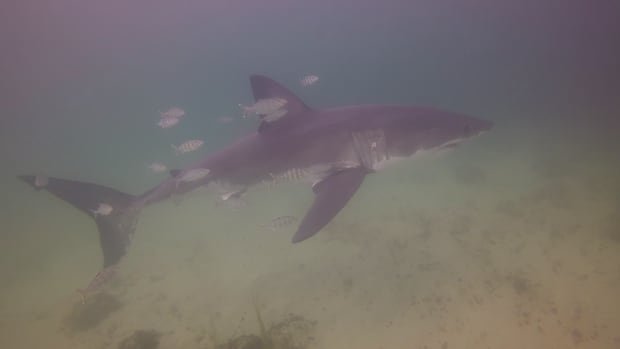

A diver sustained injuries from a great white shark in Percé, Que., within Quebec’s Gaspé region. The incident occurred around 10:30 a.m. on Wednesday, as reported by the Canadian Coast Guard.
Plongée Percé, a commercial diving company, promptly initiated emergency response procedures and provided initial first aid to the individual on-site before transferring them to a hospital. Fortunately, the diver’s life is not in jeopardy, as confirmed by the company.
The victim was on board the vessel Yoda, a Canadian Coast Guard Auxiliary dive boat. However, the nature of the injuries sustained by the victim was not confirmed by the Canadian Coast Guard by Wednesday afternoon.
Kevin Dubé, a boat captain, witnessed the event and mentioned that a mayday call alerted them to the diver’s situation. The injured person was swiftly brought ashore via a dinghy and promptly transported to the hospital by awaiting ambulances.
Plongée Percé expressed gratitude to all involved in the rescue operation and announced the suspension of diving activities for the remainder of the season.
The summer saw an increase in sightings of great white sharks in the Gulf of St. Lawrence, off the coasts of the Gaspé Peninsula, and the Magdalen Islands. Ocearch, a global non-profit organization aiding shark research, is tracking four sharks named Webster, Ernst, Bella, and Nori. Each shark’s movements provide valuable data for scientific study.
Ocearch founder Chris Fischer noted that the presence of great white sharks signifies a positive shift in the ocean’s health, citing a significant recovery from previous decades when the global shark population faced severe decline.
The sharks’ return is beneficial for local fisheries, as their presence helps regulate seal populations, in turn safeguarding fish stocks.
Marine biologist Caroline Miri emphasized the critical role of sharks in marine ecosystems, highlighting their impact on maintaining ecological balance. Ocearch has tagged approximately 115 sharks across the Atlantic region for research purposes.
The surge in great white shark sightings in the Gulf of St. Lawrence is attributed to improved documentation and the species’ recovery from endangerment status in Canadian waters. These sharks are attracted to regions with abundant grey seal populations.
Sandra Gauthier, from the Exploramer science museum, acknowledged the inevitability of such incidents with the rise in shark numbers in the gulf. She emphasized the importance of coexisting with these wild creatures and learning to adapt to their presence.
The Canadian Shark Attack Registry has recorded 15 confirmed shark-related incidents in Canada over a span of more than 330 years.