

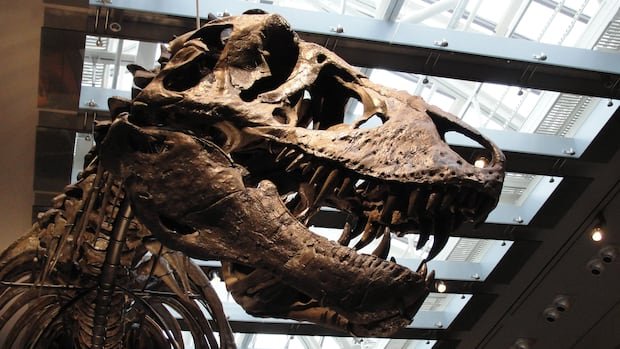

Scientists have debated the warm-bloodedness of dinosaurs for a while. However, a new study claims to have gauged the body temperature of two T. rexes using chemistry.
Aradhna Tripati, a professor and geochemist at the University of California, Los Angeles, admitted the challenges of the process. She co-authored the study published in the journal Science Advances and discussed the methodology on CBC’s Quirks & Quarks before an interview with host Bob McDonald.
To determine the temperature of extinct animals, researchers employed a chemical technique that interacts with temperature-sensitive hard tissues like tooth enamel and eggshells. These tissues contain bioapatite, a mineral where carbon atoms bond with oxygen. The study focused on carbon-13 bonding preferentially with oxygen-18, more common at lower temperatures due to stable bonds.
By comparing the “isotope clumping” in living animals with varying body temperatures, scientists could estimate the body temperature of extinct creatures like dinosaurs. A previous study by UCLA a decade ago using eggshells from titanosaurs and oviraptors suggested that these dinosaurs were warm-blooded.
In the recent study, scientists faced challenges due to the thin enamel of tyrannosaurs like T. rex. By refining their technique using megalodon teeth, they successfully analyzed small samples from T. rex teeth provided by the L.A. County Natural History Museum.
The analysis revealed T. rex’s body temperature ranged between 33.8°C and 38.8°C, akin to large mammals such as elephants and flightless birds like ostriches. This temperature was lower than smaller flying birds, typically between 41.1°C and 42.1°C.
The findings suggest that a warm-blooded T. rex could have adapted to various habitats, including the Arctic, unlike cold-blooded reptiles. Paleontologist Anthony Fiorillo praised the study, highlighting its implications for understanding dinosaur behavior and adaptations to different climates.