


Over the span of a week, Steve Finkbeiner’s research team at the Gladstone Institutes in San Francisco utilized their AI-enhanced “thinking” microscope to investigate how cellular stress affects brain cells.
By solely examining the cells without any external influences, the device not only identified the relationship but also uncovered a phenomenon known as hormesis, which is the process where certain stresses can actually bolster cellular strength. Finkbeiner, who also serves as a professor of neurology and physiology at the University of California, San Francisco, noted this finding.
What made this discovery so thrilling for him, he remarked, was that it took humanity “50 to 100 years” to make this realization, while AI accomplished it in its initial experiment.
He emphasized that this is just one instance illustrating the extraordinary potential of technology to accelerate scientific exploration. Historically, scientists have faced limitations due to insufficient resources and human constraints, such as the time required to analyze vast amounts of data. Some researchers assert that AI can accomplish in mere days what would otherwise take years.
However, promoting these advantages proves difficult when faced with a barrage of negative headlines regarding the technology, which suggest it could potentially eliminate humanity or present a substantial, if not existential, threat to society.
Concerns have been voiced by some experts and leading figures in AI about the rapid pace of technological advancement, pointing to growing evidence that it may evade human oversight. Nevertheless, such alerts have also sparked fears of excessive governmental intervention that could stifle scientific progress.
Finkbeiner expressed, “That would be the issue. These incredibly powerful, beneficial tools could be taken away from those who are working to find cures for human ailments.”
‘At the cusp’ of scientific golden age
Anima Anandkumar, a computer scientist at Caltech, asserts that AI may be ushering in a new epoch of scientific innovation.
“It’s challenging for people to grasp the cumulative impact of these developments. This resembles a new scientific golden age,” stated Anandkumar, who co-leads the AI4Science initiative. “The advancements we witnessed in the previous century transformed our lives in unimaginable ways. We are on the brink of that now.”
Five years ago, her group successfully developed a completely AI-driven high-resolution weather model that was not only significantly faster but also more precise. She noted that this technology has only gotten better since then.
“What previously required a large supercomputer can now be performed on a standard PC at home,” she explained.
She likened this advancement to the inventions of the telescope and microscope, both of which drastically enhanced scientists’ abilities to make discoveries and explore the universe’s depths.
Anthropic researcher Jacob Coxon resigned over concerns that artificial intelligence could cause human extinction within the next decade — and a slew of warnings have followed. Andrew Chang explains the spectrum of potential dangers posed by the ‘intelligence explosion’ worrying AI industry employees and experts.
(Photo credits: The Canadian Press, Reuters, Adobe Stock and Getty Images)
However, AI holds the potential for an even broader impact due to its capability to generate novel inventions by interpreting complex phenomena.
This includes aiding in the creation of improved medications, addressing sustainable energy challenges, managing extreme weather situations, and developing more efficient computing methods with advanced chips.
“For the first time in my career, I genuinely feel equipped with a tool capable of navigating the complexities of human biology,” she remarked.
Accelerating drug development
James Zou, who heads the AI for Science Lab at Stanford University, experienced a similar situation.
His team recently released a study in the journal Science detailing the establishment of a “virtual biotech” firm. They employed thousands of AI agents to collaborate, focusing on a protein associated with lung cancer and devising a related treatment — a notable demonstration of how AI can expedite drug development while reducing costs.
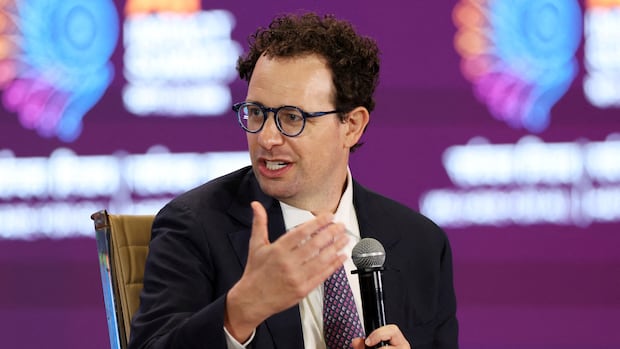
Some experts and industry insiders are warning about massive risks associated with the rapid deployment of self-improving artificial intelligence — even suggesting it could lead to the extinction of the human race. CBC’s Deana Sumanac-Johnson brings in an expert panel to separate the facts from science fiction. This panel premiered on Sept. 12, 2026.
In various scenarios, AI can condense years of work into mere days or even hours. For instance, to identify various heart diseases, doctors must manually review countless cardiac ultrasound videos collected annually. Zou’s team has developed an AI algorithm capable of diagnosing conditions from these recordings in just a few seconds.
“This exemplifies how AI can transform a task that typically requires time and human expertise into a process that is significantly faster and more cost-effective through automation,” he explained.
AI firms themselves seem concerned
Nevertheless, Zou acknowledged that experts must utilize AI judiciously and keep it under scrutiny, particularly for high-risk applications.
Concerns regarding the technology’s potential to harm humanity are not entirely baseless. AI leaders have themselves advocated for a slowdown in its development following several incidents where agents behaved unpredictably.
Similarly, an Anthropic researcher resigned last month due to worries that the company was “gambling with our lives.” Evan Hubinger, the lead of alignment science at Anthropic, concurred, asserting online that Anthropic genuinely believes AI could annihilate all humans, estimating the probability at over 10 percent within the next ten years.
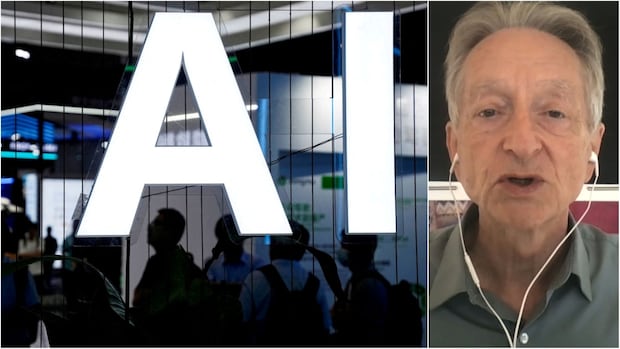
U.S. President Donald Trump is hosting a summit in Washington with the top leaders in AI development. Trump has dismissed warnings over artificial intelligence, arguing for the need to stay ahead of China in the AI arms race. Geoffrey Hinton, who is considered the ‘godfather’ of AI, says Trump ‘doesn’t really understand’ AI and is ‘ill-advised’ about it.
Zou expressed concerns about some of the regulatory ideas circulating regarding the limitation of open-source AI models.
While he did not share the same apprehension about AI threatening humanity, he advocated for a balanced perspective, recognizing that it carries risks similar to any other technology.
“We need to meticulously assess and manage those risks while also acknowledging the numerous advantages offered by technologies like AI,” he stated.
Meanwhile, Finkbeiner indicated that his team has already felt the effects of some AI restrictions. Last summer, the Trump administration limited access to Anthropic’s latest Claude chatbot versions for foreign nationals due to cybersecurity worries, causing the company to withdraw the products from all users.
-
AI researchers ‘earnestly believe’ it could kill all humans within the next decade, Anthropic employee says
-
Is AI evolving too fast? A look at the debate on slowing it down
Although the restrictions have been lifted, access to the latest models is now restricted to a select group of U.S.-based, government-sanctioned organizations, compelling Finkbeiner’s team to resort to using the most basic model of Claude.
“If the significant advantage is its ability to manage complexity, being forced to use a model that cannot handle such complexity severely limits the potential impact on these challenging problems,” he explained.
Finkbeiner had a message for regulators considering AI oversight: Keep in mind that there are patients “who have been waiting a long, long time for a cure or treatment.”
“There’s a lot at stake. There are many beneficial things I can achieve today. Please do what you can to protect those,” he urged.