

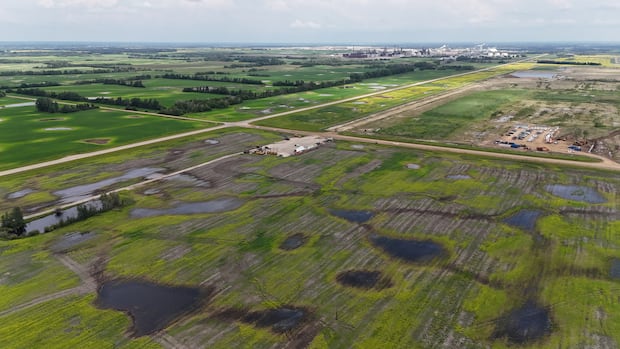

It is widely recognized that data centres utilizing artificial intelligence consume a substantial amount of electricity. However, it remains uncertain if this will lead to increased energy expenses for consumers in Alberta.
According to a recent analysis by the Pembina Institute, a clean-energy think-tank, the forthcoming Meta Data Centre in Sturgeon County, Alberta — one of the largest proposed data centres in the province — could result in household electricity bills increasing by an annual amount ranging from $270 to $460 once it becomes operational.
David Pickup, the director of energy at the Pembina Institute, remarked, “The prospect of average household bills increasing by hundreds of dollars over the years serves as a significant reminder of the potential effects these projects can have.”
Data centres serve as physical locations that accommodate the computing systems required for storing and distributing data for various tech applications that leverage AI.
As reported by the U.S. Department of Energy, data centres represented 4.4 percent of electricity consumption in the United States in 2023, with projections suggesting this figure could rise to 12 percent by 2028.
In July, Meta Platforms Inc., the parent company of Facebook and Instagram, revealed intentions to construct a data centre complex costing $13 billion, anticipated to be operational within the next two to three years.
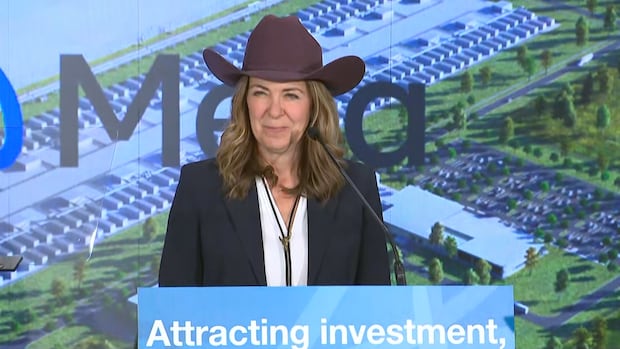
Meta announced plans on Wednesday for a large AI data centre in central Alberta, marking the company’s debut in Canada. Premier Danielle Smith, alongside other officials from the government and Meta, unveiled the 1-gigawatt data centre, which has raised concerns regarding its energy requirements.
This facility will be connected to an adjacent power plant, the $4.6-billion Greenlight Electricity Centre, which is designed to generate 932 megawatts of power and has the capability to eventually double that output.
Nonetheless, Meta has the rights to link to Alberta’s electrical grid even before the Greenlight plant becomes operational, which is projected to happen by late 2030.
Both the provincial government and Meta have stated that the data centre in the Edmonton area will not increase electricity costs for Albertans.
However, the time gap between the data centre’s launch and the construction of its associated power plant is a significant element likely to exert upward pressure on electricity prices for consumers, as indicated by the Pembina report and experts consulted by CBC.
Dynamics of Supply and Demand
Pickup noted that the effect on electricity pricing will be most pronounced in the years leading up to the Greenlight plant’s launch, with a decrease expected once additional supply becomes available. This period is estimated to span from 2027 to 2031.
Kent Fellows, an associate professor of economics at the University of Calgary, stated that a project as large as Meta’s data centre could influence electricity prices if new generation capacity does not come online concurrently.
“A data centre consuming a substantial amount of electricity, comparable to that of a sizable town or even a small city, will certainly affect the market if it lacks its own power generation,” remarked Fellows.
Fellows explained that without its own power plant, Meta’s operations could lead to elevated wholesale electricity prices.
In Alberta, when wholesale prices rise, retailers often adjust their prices accordingly to cover expenses and maintain profit margins.
Fellows further noted that the impact would diminish once Meta’s own generation capacity is established.
“It’s essential to remember that this operates like any other market,” he said. “There are aspects of supply and demand at play.” Werner Antweiler, a professor at the Sauder School of Business at the University of British Columbia, pointed out that Meta could require nearly one gigawatt of electricity for its operations.
This demand represents about 10 percent of Alberta’s current generating capacity. For comparison, the city of Edmonton has a demand of approximately 1.4 gigawatts, according to the Alberta Electric System Operator.
“This will eliminate the supply cushion,” Antweiler remarked, referring to the extra electricity available in the power grid that helps prevent blackouts during sudden plant failures or spikes in demand.
“When the supply cushion is removed from the grid, prices rise as peak load plants are utilized more frequently,” he added.

Demonstrators gathered in Morinville, Alta., this past Sunday to protest the proposed Meta data centre in Sturgeon County. Ben Baril was the organizer of last weekend’s event.
Antweiler indicated that the Pembina Institute’s prediction of a roughly 15 percent rise in electricity rates is credible. However, he acknowledged considerable uncertainty regarding the exact percentage, stating, “It could be 10 percent, 15 percent, or even 25 percent.”
“These figures are not easily dismissed, as they align with the anticipated demand trends,” he added.
A Cumulative Impact
The Alberta government is actively attracting technology leaders like Meta and Google to establish operations in the province.
By late 2024, Technology and Innovation Minister Nate Glubish expressed the province’s ambition to have $100 billion worth of data centres under construction within five years.
While the Pembina report focuses specifically on the Meta data centre, it suggests there could be a cumulative effect.
“We expect similar, significant, and long-lasting effects as more data centres are established in Alberta,” the report states.
-
Meta building its first Canadian data centre northeast of Edmonton
-
Alberta premier offers reassurances on massive Meta data centre
Pierre-Olivier Pineau, a professor and energy policy expert at HEC Montréal, suggested that the potential repercussions would extend beyond Meta.
“An increase in load means an increase in demand, which in turn puts pressure on supply,” Pineau explained. “As demand escalates, prices rise, reflecting the market’s response.”
Pickup indicated that renewable energy sources, battery storage, and other technologies might help bridge the supply gap, alongside mandates for data centres to curtail their energy consumption during peak demand times.
In a recent video shared on social media, Premier Danielle Smith assured that if electricity supplies become constrained, the homes of Albertans will be prioritized, as the province’s grid emergency protocols prioritize households and essential services over industrial users.
“These projects can lead to substantial consequences, but they don’t have to,” Pickup stated.
“Effective policy can determine whether these projects significantly impact consumers or become beneficial to the grid and help lower costs.”
Pickup added that alternative energy sources like solar and wind could alleviate some of the timing and cost challenges associated with launching a new gas plant.
Using gas plants to supply electricity to the Meta data centre, Pickup noted, could potentially exert further pressure on natural gas prices.
Alberta and Meta Deny Price Increases
With the prospect of additional data centres becoming operational, the federal government recently introduced new guidelines for responsible data centre development, stipulating that these facilities should not transfer electricity costs to Canadians.
The other principles emphasize that data centres should generate lasting local advantages, minimize their environmental footprints, maintain transparency regarding local effects, and provide strategic value to Canada.
To date, 42 organizations across Canada, including Meta, have endorsed this framework.
In a statement to CBC, a Meta representative remarked that the report is based on hypothetical scenarios and asserted that they will finance new generation and grid enhancements, which would lead to reduced prices for Albertans.
“Meta covers all costs associated with energy upgrades and the electricity consumption of our Sturgeon County data centre — these expenses will not be passed on to Albertans — and we are committed to matching 100 percent of the facility’s electricity needs with clean and renewable energy,” the statement read.
A representative for Alberta’s minister of affordability and utilities conveyed to CBC that the analysis by the Pembina Institute does not accurately reflect how Albertans are charged for electricity and argued that the heightened demand from data centres could attract new generation capacity, potentially leading to lower power prices.
“Our government has guaranteed that every Albertan has access to a fixed-rate plan for two years, with increases regulated by law,” the statement mentioned.