


On Monday, the administration of U.S. President Donald Trump declared an enhancement of secondary sanctions that can be enforced on entities and nations maintaining commercial relations with Iran, thereby significantly increasing economic pressure on Tehran as the conflict approaches its six-month milestone.
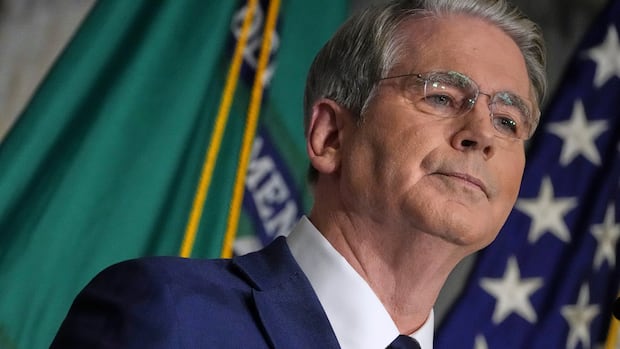
During a press briefing, Treasury Secretary Scott Bessent introduced what he referred to as an “economic D-Day,” designed to provide nations with a final alert to cut business connections with Iran or face the possibility of critical companies being excluded from the dollar-based financial framework.
“We are initiating a vigorous economic assault on Iran’s financial links worldwide. Our goal is to eliminate every economic lifeline that supports this oppressive regime until Tehran stands isolated,” Bessent stated.
The U.S. Treasury Department announced that it has identified the networks, facilitators, and financial pathways Iran utilizes to smuggle oil and bypass sanctions, indicating that Washington will collaborate with U.S. allies to target any source of Iran’s “illicit revenue.”
The department disclosed that it has made determinations against five sectors — digital assets, technology, gold, aviation, and shipping — which the Iranian government exploits to bolster its economy. Additionally, the Treasury has enacted sanctions on nearly 60 entities, individuals, and vessels.
For several years, China has been the largest importer of Iranian oil. Washington has escalated its efforts to restrict Chinese purchases, yet has not yet designated larger Chinese banks that could be aiding this trade.
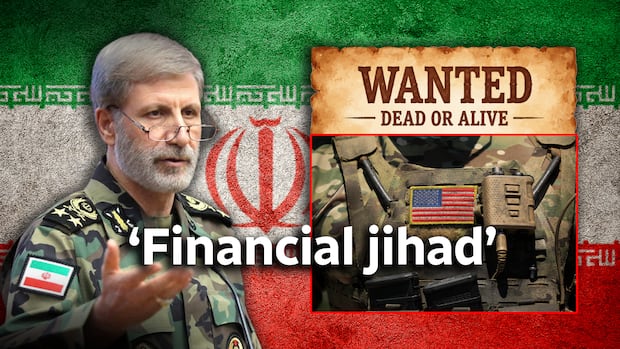
Iran is offering a $30,000 US bounty to any Iranian who can capture or kill American soldiers. Andrew Chang breaks down why the timing of the announcement matters, its propaganda value, and how realistic it actually is.
(Photo credits: The Canadian Press, Reuters, Adobe Stock and Getty Images)
‘Wait for an attack,’ Iran warns
Prior to the announcement, Iran cautioned of a potential military retaliation and a further decrease in oil exports from the Gulf in reaction to any U.S. economic actions.
Following the announcement, Iranian Finance and Economic Affairs Minister Ali Madanizadeh stated, “We are entirely ready for the U.S. sanctions.”
“It is clear that the adversaries aim to launch an economic terrorist attack against us, but we also possess our own resources and understand how to navigate the situation. Our defense is no longer purely defensive; the adversaries should expect a counterattack,” Madanizadeh informed state television.
Brig-Gen. Hossein Mohebbi, a spokesperson for Iran’s Islamic Revolutionary Guard Corps (IRGC), pledged severe repercussions to U.S. essential interests and energy chokepoints if Iran’s infrastructure is at risk, as reported by Press TV.
The conflict between the U.S. and Iran is approaching its six-month point and has led to a rise in global energy prices. Although intense fighting has lessened, diplomatic attempts to resolve the situation have stagnated, and oil and raw material shipments through the Strait of Hormuz remain obstructed, keeping energy prices high.
Trump’s approval ratings have dropped to a record low, with only 33 percent of Americans in the latest Reuters/Ipsos poll expressing approval of his performance. He asserts that the economic repercussions are essential to prevent Iran from acquiring nuclear capabilities.
The U.S. has imposed sanctions on Iran for decades. Most of these measures have been directed at limiting the nation’s oil profits, focusing on its aviation sector and cryptocurrency operations, restricting its acquisition of weapon components and military equipment, and cutting funding for businesses controlled by the IRGC, a significant player in the Iranian economy.
These sanctions exclude designated entities from the dollar-based financial system, yet Iran has adeptly established new front companies, entities, and vessel registrations to circumvent them.