

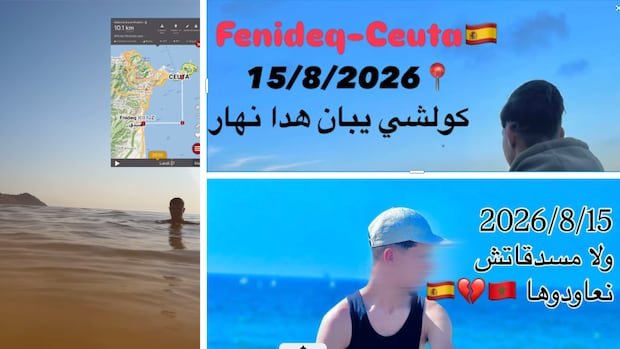

In the days leading up to a significant influx of migrants into Europe, a brief video shared on Instagram gained 1.4 million views. The video depicted a young man submerged in water with a map illustrating a sea route from Fnideq, Morocco, to Ceuta, a Spanish enclave on the northern edge of Africa. The content creator later claimed “we’ve arrived” in response to comments.
This video was just one of many viral posts across platforms like Instagram and TikTok that seemed to play a role in mobilizing multiple waves of irregular migration from Morocco to Ceuta. The most recent attempt on August 15 resulted in numerous arrests.
These online accounts are part of a larger network focused on migration-related culture, incorporating music, memes, and imagery. Some of these accounts exploit the aspirations of primarily African and Middle Eastern youth seeking better opportunities abroad.
There is a debate among governments and organizations regarding whether a single entity orchestrated the events in Ceuta or if migration was manipulated for geopolitical purposes. Nevertheless, it is evident that misinformation, amplified through various online communities, contributed to the surges of migrants towards Ceuta this summer.
CBC’s visual investigations team, in collaboration with Sebastian Vandermeersch of Bellingcat, identified numerous social media accounts on platforms like Instagram that were active prior to the initial wave on July 30. The proliferation of posts was initially spurred by misinformation suggesting a Spanish court ruling would no longer reject migrants arriving by sea. Faceless accounts then started promoting the idea that the crossing was feasible, using similar language and visuals, resulting in millions of views.
The aftermath was profound: over 72,000 individuals crossed the border on July 30, overwhelming authorities in Ceuta and triggering a political crisis in Europe. While the majority have since returned to Morocco, around 5,000 remain in Ceuta, with some residing on a beach with assistance from charities. Tragically, nearly 100 individuals lost their lives in the crossing attempt.
This scenario highlights how misinformation and manipulation, when propagated through online channels and targeted at desperate individuals, can have tangible real-world consequences. Moustafa Ayad, the Executive Director for Africa, the Middle East, and Asia at the Institute for Strategic Dialogue, emphasized the impact of the surge in social media activity over the past month.
Multiple social media accounts guided followers to WhatsApp chats for planning crossings and shared information on how to reach Ceuta. Some accounts even provided direct advice through their feeds. For instance, a popular Instagram video titled “the shortest distance” pointed out a reinforced fence with barbed wire, indicating the best spot for crossing into Spain.
Following the events of July 30, Meta and TikTok agreed to fact-check posts to prevent criminal organizations from exploiting misinformation for profit. However, a new wave of posts emerged ahead of August 15, advertising it as the next opportunity for entry into Spain. Several of the same accounts involved in the July 30 crossing, along with newly created accounts, were active before August 15.
Numerous reports from Morocco revealed that hundreds or more individuals attempted to reach the border on August 15. Both Moroccan and Spanish authorities were prepared this time, deploying thousands of police on both sides of the border. Moroccan state broadcasters reported the arrest of nearly 300 migrants that Saturday.
The government had been monitoring social media posts encouraging the crossings and pledged to take action against those responsible. Some Instagram accounts linked to the July 30 events have since been deactivated.
The surge in online activity was fueled, in part, by the increasing number of migrants successfully reaching Ceuta before the Spanish court ruling, as noted by the Mixed Migration Centre. Ceuta had become the primary entry point into Spain in the first quarter of the year, attracting more than 2,200 individuals by land by the end of May.
While social media played a role in shaping misinformation, Bram Frouws, Director of the Mixed Migration Centre, cautioned against attributing the surge solely to online platforms. He emphasized that social media did not create the desire to migrate, which preexisted. Many accounts identified by CBC seemed to mirror the widespread discontent and desperation among young people in North Africa and beyond, employing aspirational content that glorifies migration.
The response to these posts underscores the profound desperation experienced by many individuals seeking better opportunities. With high unemployment rates among youth in countries like Morocco, coupled with limited political agency and rights, the migration-related messaging may resonate as a beacon of hope.
Given that Ceuta and Melilla serve as the only land borders between Africa and a European nation, many of these accounts likely originate from North African countries such as Morocco and Algeria. Some reports suggest additional origins in Italy and Turkey. These accounts often use European flags and hint at various European destinations without explicitly offering passage.
Through evocative imagery and messages, these accounts attract thousands of followers seeking departure. Despite attempts to contact accounts related to the July 30 and August 15 events, CBC received no responses.