

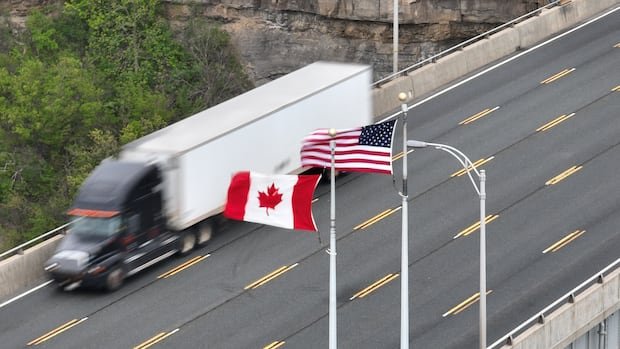

Trade negotiations to avoid additional U.S. tariffs are ongoing, with a recent report highlighting the potential repercussions if the Canada-U.S.-Mexico Agreement (CUSMA) were to collapse. The analysis, conducted by Oxford Economics for the Canadian American Business Council, explores three possible outcomes of the trade discussions between the U.S. and Canada.
In a scenario where CUSMA is terminated, the report predicts a loss of 214,000 jobs in the U.S. and 102,000 jobs in Canada compared to the current status quo. Conversely, successful renegotiation of CUSMA could lead to job gains of 137,000 in the U.S. and 98,000 in Canada.
Beth Burke, CEO of the Canadian American Business Council, emphasized the significance of the trading relationship between the two countries, pointing out the impact on job security and economic stability for citizens on both sides of the border.
The economic consequences extend beyond employment figures. In the event of a breakdown, both countries would face substantial GDP losses, totaling $1.04 trillion for the U.S. and $271 billion for Canada by 2035. Inflation rates are expected to rise, while real disposable income growth would be constrained, particularly in Canada.
The report highlights potential challenges for manufacturing industries in the worst-case scenario, with sectors such as auto, wood products, and metal manufacturing in the U.S. being heavily affected. Similarly, Quebec and Ontario in Canada would bear the brunt of the impact if CUSMA were to falter.
As the deadline for new tariffs approaches, officials are working to reach a deal to avert the imposition of 50% tariffs on various Canadian exports. Trade negotiations between Canadian Trade Minister Dominic LeBlanc and U.S. Trade Representative Jamieson Greer are ongoing, aiming to present a trade agreement to President Trump before the tariff deadline.
Burke expressed optimism about the ongoing talks but noted that concessions may be necessary from both sides to secure a deal. Failure to reach an agreement could result in severe repercussions for certain manufacturing sectors in central Canada, according to recent projections.
The looming threat of tariffs stems from grievances over trade practices, including alleged discrimination against U.S. dairy products and retaliatory measures. Negotiators are exploring strategic sectors in the hope of reaching a resolution before the tariff deadline.
Recent reports suggest that cement, concrete, paper, wood, computers, electronics, plastics, and rubber industries would be significantly impacted by tariff hikes. Provinces like Ontario, New Brunswick, and Quebec are expected to be hardest hit due to their reliance on these sectors, while others like Saskatchewan, Alberta, and Newfoundland and Labrador may fare relatively better.
Overall, the report underscores the critical importance of successful trade negotiations to preserve jobs, economic stability, and mutual prosperity for both Canada and the United States.