

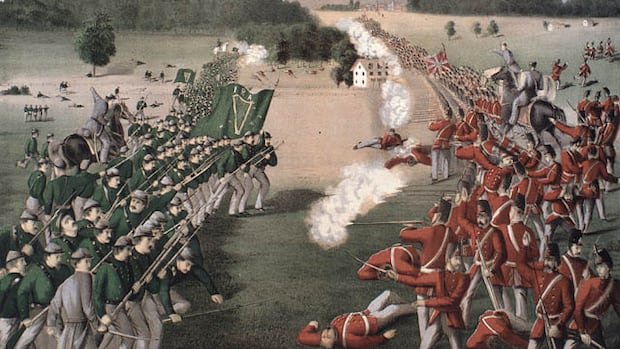

An overlooked clash that occurred on Canadian territory a year before Confederation may not resonate in the historical memory of Canadians beyond Fort Erie, Ontario. However, the Battle of Ridgeway — also known as Limestone Ridge — in 1866 holds significance for several historical reasons.
This battle marked the first instance where Canadian troops, under Canadian leadership, engaged in combat. It also served as the inspiration for Decoration Day, a precursor to Remembrance Day observed in certain regions annually. Despite these milestones, the nine individuals who perished in the battle are not included in the Books of Remembrance, a compilation on Parliament Hill commemorating soldiers who lost their lives in service to Canada.
A fresh petition set to be brought forward in the House of Commons aims to have these nine individuals, along with the numerous casualties following the battle, acknowledged in the list. Conservative MP Fred Davies, who is championing the petition, emphasized the importance of honoring those who made the ultimate sacrifice in defense of Canada.
The Battle of Ridgeway was not a resounding victory for the Canadian forces. Inexperienced volunteers confronted Fenian raiders, many of whom were veterans of the American Civil War. The Fenian Brotherhood, an Irish American movement striving for Irish independence, sought to achieve this goal by invading and holding parts of British North America to negotiate with Britain.
In 1866, a group of raiders crossed the Niagara River with intentions to target the Welland Canal, encountering around 800 Canadian volunteers from various regiments at Limestone Ridge near Ridgeway and Fort Erie. Historian Peter Vronsky noted the rapid mobilization of Canadians in the region but highlighted the lack of preparation among Canadian troops for what he termed as Canada’s initial modern battle.
Despite facing challenges like inadequate supplies and ammunition shortages, the Canadians engaged the invaders in combat. Following a Fenian bayonet charge, the Canadian forces retreated in a somewhat disorderly manner, prompting the Fenians to abandon their incursion and retreat to the U.S. side of the Niagara River.
While the Battle of Ridgeway resulted in a battlefield setback, it underscored the bravery and dedication of those who fought to safeguard Canada from external threats. The sacrifice of the fallen soldiers remains significant, irrespective of the battle’s outcome.
A memorial commemorating the nine fallen soldiers was established in 2016 on the battle’s 150th anniversary. Efforts have been made by Fort Erie officials to have these individuals recognized in the Books of Remembrance, as they played a crucial role in shaping Canada’s history.
Although the battle occurred before the formation of Canada as a nation, the Books of Remembrance include soldiers who perished prior to Confederation, such as in the War of 1812. The Battle of Ridgeway is believed to have had a direct impact on the Confederation process, influencing individuals to support the idea and contributing to the formation of Canada.
Several regiments that participated in the 1866 battle, including the Queen’s Own Rifles and the Royal Hamilton Light Infantry, continue to exist today. This battle was pivotal in testing and shaping Canada’s modern armed forces, marking a significant moment in Canadian military history.