

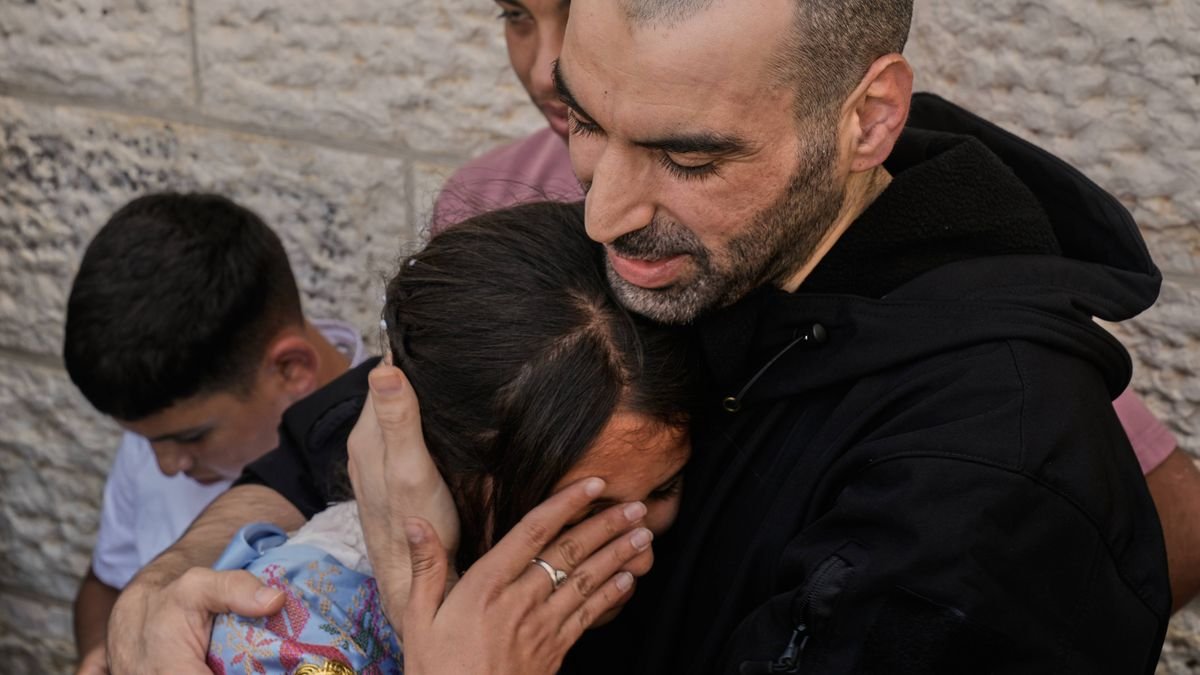

Palestinians are joyous in the wreckage of Gaza following Israel’s release of nearly 2,000 prisoners in exchange for Hamas’s liberation of hostages. This significant ceasefire agreement has brought many detainees back to their families, yet some now confront the prospect of exile overseas.
One former captive revealed the harrowing toll of his imprisonment, shedding over nine stone (59kg) during what he described as an unimaginable ordeal of hunger, mistreatment, oppression, torture, and verbal abuse. Kamal Abu Shana, 51, from Tulkarem in the West Bank, shared his distressing experience of suffering.
Family members expressed shock at Kamal’s transformation, noting that he is unrecognizable compared to the man they once knew. His niece lamented, “He’s a different person now. Our uncle is not the same.”
On Monday, two busloads of prisoners were set free in the Israeli-occupied town of Beitunia in the West Bank. The freshly released men, sporting shaved heads, disembarked from the buses, displaying victory signs. Some were hoisted onto the shoulders of the crowd, while others slumped into nearby chairs, visibly drained.
The prisoner releases hold profound significance for both sides. Israelis find them deeply distressing, as some of those being freed were convicted for attacks resulting in civilian and military casualties. Meanwhile, for Palestinians, the issue of prisoners carries immense political weight, with virtually every Palestinian community having been impacted by Israeli detentions, particularly involving young men.
Many Palestinians view the prisoners as courageous fighters resisting the prolonged Israeli military occupation. Previous exchanges have been meticulously orchestrated by both sides to control the optics, attire, and ceremonies due to their sensitive political nature.
The group of 2,000 includes around 1,700 Palestinians captured by Israeli forces from Gaza during the two-year conflict and detained without formal charges. Among those to be released are 250 Palestinians serving prison sentences, primarily for murder and terrorism linked to fatal assaults on Israelis dating back decades, alongside others convicted on lesser charges.
Anticipation ran high in Khan Younis, a city in southern Gaza, as large crowds gathered outside Nasser Hospital to welcome the returning detainees. While some of the convicted individuals will be allowed to return to East Jerusalem or the West Bank, the majority are slated to be relocated to Gaza or forced into exile abroad.
Before the releases, Palestinians congregated on hills near Ofer Prison in the West Bank, awaiting the arrival of their loved ones. An armored Israeli vehicle ascended the hill from the prison, firing tear gas and rubber bullets at one section of the hill, causing the crowd to disperse as drones buzzed overhead.
A distributed flier warned against supporting what it deemed “terrorist organizations,” cautioning of potential arrest for those who defy the directive. Israeli forces also issued warnings in West Bank neighborhoods, indicating repercussions for participating in celebratory activities related to the prisoner releases.
The swift developments post-ceasefire agreement have left uncertainties lingering till the final moments regarding the identities of those to be freed. Hamas released a list of over 1,900 prisoners and detainees slated for release, while Israel’s confirmation of the list remained pending.
Israel provided limited details on the impending release of the 1,700 detainees from Gaza. During the conflict, Israeli forces apprehended thousands of Palestinians through raids on shelters, hospitals, and checkpoints, often intercepting families fleeing their residences amidst military operations.
Despite Monday’s releases, approximately 1,300 Palestinians from Gaza remain under Israeli custody, as indicated by a count by the Israeli human rights organization, Hamoked, in September.
According to Hamas’s roster, the Gaza detainees set for release encompass two women, six minors under 18, and roughly 30 individuals over 60 years old. Many of these detainees were held under new Israeli laws enacted at the conflict’s onset, authorizing extended detention periods for Palestinians deemed “unlawful combatants” without judicial oversight or legal representation.
Reports from rights groups, the UN, and detainees have highlighted routine mistreatment in detention facilities, including physical abuse and inadequate sustenance. Israel maintains that it upholds prison standards in compliance with the law and investigates any alleged violations.
The list of 250 convicted prisoners slated for release spans ages 19 to 64, with 159 associated with Fatah and 63 with Hamas, along with unaffiliated or other group members. Most were arrested during the early 2000s amid the Second Intifada, a violent Palestinian uprising triggered by frustration over enduring occupation despite prior peace negotiations.
Some prisoners faced military trials criticized for lacking due process, while others endured prolonged detention without trial under administrative custody. Israel defends this practice, often condemned by Palestinians and human rights groups, citing the need to thwart attacks and safeguard sensitive intelligence.
Notably absent from the list are several high-profile detainees, including Marwan Barghouti, Hassan Salameh, Ahmed Saadat, and Abbas Al-Sayyed, with