

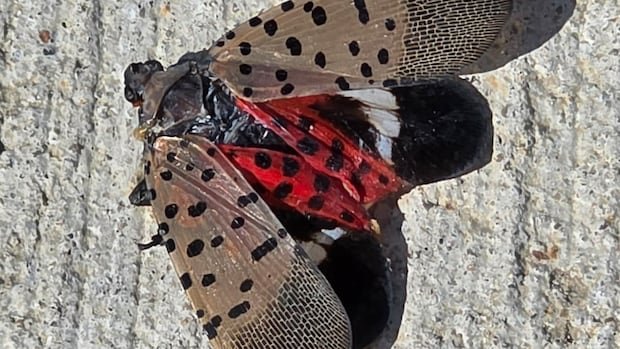

An alien insect notorious for destroying grapevines and impacting various crops and trees has been identified in Canada for the first time by the Canadian Food Inspection Agency (CFIA). This initial discovery took place in Windsor.
Windsor residents had previously reported sightings of the spotted lanternfly, as disclosed by a non-profit organization dedicated to halting the spread of invasive species. However, this recent detection marked the first instance through an agency survey, as confirmed by the Invasive Species Centre.
The Invasive Species Centre emphasized the detrimental effects of the spotted lanternfly, stating that it poses a significant threat to grapevines, potentially causing severe repercussions for the grape and wine industry. Moreover, the pest has the capacity to harm other crop growers, as well as the horticulture and forestry sectors, along with residential yards and neighborhood parks. Uncontrolled spread of the spotted lanternfly could lead to extensive economic, ecological, and social consequences.
Originally native to southeast Asia, the spotted lanternfly was initially spotted in North America in Pennsylvania in 2014. This insect has a wide range of host plants, feeding on the sap of over 100 different species.
The Invasive Species Centre is urging the public to familiarize themselves with the appearance of the insect. If individuals come across the fly or its eggs, they are advised to capture them, place them in a sealed plastic bag or container, and promptly report the finding to the CFIA. The release emphasized the importance of all Canadians reporting any suspected sightings of the spotted lanternfly to the CFIA with precise location details and accompanying photos for proper action.
To aid in identifying the spotted lanternfly, the Invasive Species Centre and CFIA have shared several tips. Adults of the species are approximately 25mm long and 12mm wide, with distinct features on their wings and abdomen. Nymphs go through color changes as they develop, while eggs appear as grey smears on host trees or hard surfaces.
The insect’s excretion of honeydew, a sticky substance, can accumulate at the base of trees, promoting the growth of sooty mold and attracting bees and wasps.
In efforts to curb the spread of the spotted lanternfly, the Invasive Species Centre recommends checking vehicles and outdoor items for eggs, nymphs, or adults when visiting areas with known infestations, considering high-pressure car washes, and refraining from moving firewood to prevent further dissemination.