


University of Waterloo doctoral candidate Kaveeshan Thurairajah, although not a Nobel Prize winner, can now proudly claim an Ig Nobel Prize. The Ig Nobels, a whimsical take on the prestigious Nobel Prizes, honor the most peculiar and innovative research in academia. Thurairajah, in collaboration with his team, secured this year’s Ig Nobel Physics Prize for their work on creating a urinal that prevents splashes.
Upon receiving the news from his supervisor, fluid physicist Zhao Pan, Thurairajah expressed his joy at the achievement. The team designed and tested various urinal prototypes, such as the Nautilus and Cornucopia, with Nautilus being the preferred choice due to its reduced splashing and ease of cleaning.
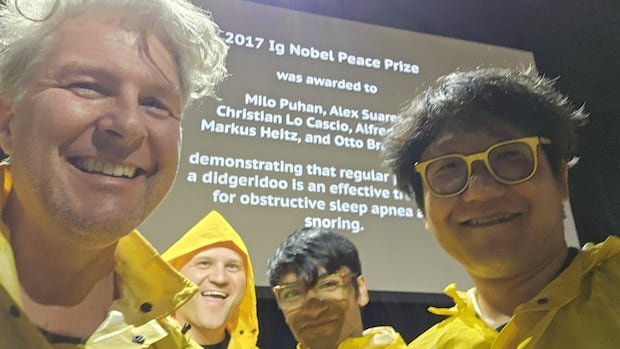
Attending the award ceremony in Zurich, Thurairajah and his team sported bright yellow raincoats, prepared to receive accolades from their fellow unconventional scientists. Despite the nature of their research, Thurairajah clarified that no actual urine was involved in their experiments. They developed a scientifically accurate device to simulate urination rates for testing purposes.
While acknowledging the light-hearted aspect of their work, Thurairajah emphasized the practical implications of their research in enhancing public restroom facilities. The study findings were published in the journal PNAS Nexus last year.
In addition to Thurairajah’s team, other Canadian researchers were recognized at the ceremony. A team from the University of Toronto won the Economics Prize for their study on the unethical behavior of affluent individuals, while McGill University scientists were part of the team honored for using mosquito proboscises in advanced 3D printing.
The Ig Nobel Prizes, presented by the magazine Annals of Improbable Research, relocated to Europe after 35 years in the U.S. due to visa concerns for attendees. Thurairajah, emphasizing the international collaboration in scientific endeavors, supported this decision, highlighting the importance of inclusivity and global participation in the scientific community.