

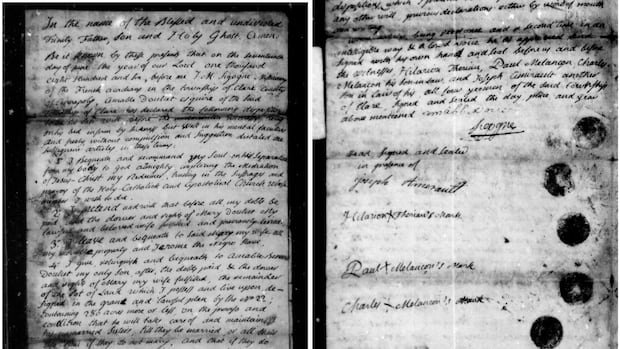

When Hilarion Thériault sensed his approaching end at the age of 71, he made the unusual decision to draft a will, a practice not common among Acadians in the 19th century. This was primarily due to the fact that many Acadians had little property to bequeath, having lost land and homes during the Acadian deportation period. Moreover, Roman Catholics in the region were prohibited from owning property until the 1780s, leading to struggles in obtaining land titles even when living and working on the land.
Thériault’s will, described as being “unwilling to die unprepared,” reflected his desire for his debts to be settled and reparations for any injustices to be made in his memory, aiming to bring peace to his family. Colby Gaudet, a post-doctoral researcher at Dalhousie University, delved into Thériault’s will and 23 others from the Clare, N.S., Acadian community to explore how families navigated the legal and religious aspects surrounding death and mourning.
Gaudet highlighted that the wills were not only acts of resistance but also adherence, as Acadians followed existing Anglophone property norms while emphasizing their Roman Catholic faith. These wills, overseen by predominantly Anglo-Protestant county judges, presented a language barrier for Acadians who had to express their wishes in a language unfamiliar to many.
The historical context of great social exclusion faced by Acadians, particularly after the 1755 deportation ordered by Lt.-Gov. Charles Lawrence, was essential in understanding the significance of these wills. Maurice Basque, a historian at l’Institut d’études acadiennes at the Université de Moncton, emphasized the British Crown’s appropriation of Acadian land to resettle individuals from New England, intending to diminish the Acadian population in the region.
The wills studied by Gaudet shed light on racial dynamics in Clare, revealing interactions between Black individuals and Acadians. For instance, Amable Doucet’s will mentioned passing a Black slave named Jerome to his wife, while another will involved a Black man from New York who had been an indentured servant and later became a free member of the community. These insights provided a deeper understanding of the intricate relationships within the Acadian community during that era.
Overall, the wills examined by Gaudet not only reflected the legal and religious complexities faced by Acadians in the 19th century but also highlighted their unwavering commitment to their Catholic faith and community values.