
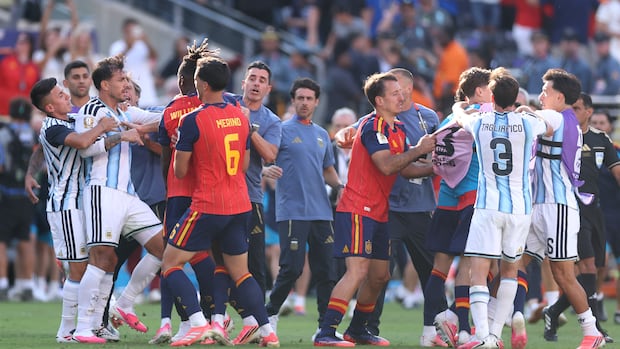

On Friday, FIFA announced the suspension of three Argentine players, including a significant 10-match ban for midfielder Leandro Paredes, for physically confronting Spanish players following their defeat in the World Cup final.
Paredes’ suspension stems from his actions where he grabbed Spain’s Eric Garcia by the neck and pushed Gavi to the ground. This penalty is among the harshest handed down in World Cup history, comparable to the sanctions imposed on Uruguay striker Luis Suarez in 2014.
Defender Nahuel Molina received a seven-match suspension, while Thiago Almada was dealt a one-match ban. Additionally, fines of $90,000 were levied against Paredes and Molina, with Almada facing a $30,000 penalty.
Paredes’ ban effectively removes him from the Argentine national team for nearly a year since the FIFA calendar includes 10 matches scheduled until June 2027.
Currently, all these matches may be friendlies, as no competitive fixtures are lined up at this time.
Gavi also suspended for England match
Gavi has been suspended for one match as well, which will be a Nations League game against England at Wembley on September 26.
Roberto Ayala, an Argentina coach, received a three-match ban along with a $30,000 fine.
The Argentine Football Association (AFA) was fined a total of $110,000 due to various incidents during the World Cup, including players displaying a political banner regarding the Falkland Islands after their semifinal victory against England, as well as discriminatory chants from fans.
Furthermore, FIFA mandated that the AFA allocate $100,000 towards anti-racism initiatives. Argentina had previously received $34 million in World Cup prize money from FIFA.
Argentina likely to challenge the decision
The AFA has the option to appeal the lengthy bans and fines to FIFA and, potentially, to the Court of Arbitration for Sport thereafter.
In a statement, the federation noted, “The AFA legal department will timely seek from FIFA the rationale behind the reviewable decisions in order to submit appeals to the governing body’s appeal committee, while also keeping the option of appealing to the CAS as a final measure.”
Cases of Suarez and Simunic
In 2014, Luis Suarez faced a four-month ban from all soccer, including from his new club Barcelona, along with an additional eight-match suspension for Uruguay after biting Italian defender Giorgio Chiellini during a World Cup group stage match in Brazil.
Paredes’ 10-match suspension is similar to the one given to Croatia’s Josip Simunic in 2013 after a World Cup qualifying playoff, where Simunic used a megaphone to lead fans in chants linked to the pro-Nazi regime during World War II.
The incidents during last month’s final in East Rutherford, New Jersey, which FIFA classified as assault cases, followed Argentina’s loss to Spain, where they struggled to make an impact and rarely created scoring opportunities.
Spain’s Ferran Torres netted the sole goal in the second half of extra time after Argentina midfielder Enzo Fernandez was shown a red card.
FIFA’s disciplinary judges also mandated that Argentina host its next home match in a stadium at only 50% capacity. A second stadium sanction and a $100,000 penalty were postponed for probationary periods.