

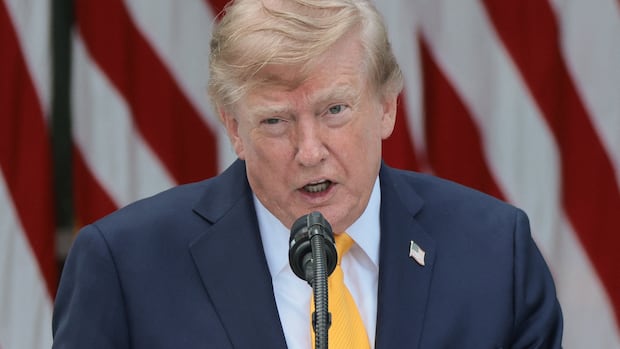

On Tuesday, the White House released a statement outlining “facts” regarding Canada’s exploitation of its trade relationship with the United States “for decades.”
This development is part of the escalating trade conflict between the two nations. Negotiations concerning tariffs fell apart on Friday evening after Prime Minister Mark Carney withdrew, stating that the U.S. “demanded too much and offered too little.”
Some assertions made by the White House about Canada are accurate, while others reflect U.S. President Donald Trump’s longstanding opinions or claims that are subject to debate. Below is an overview of the White House’s statements.
-
Federal ministers announce support for Canadians, counter-tariffs against U.S.
-
Q&A
Canada ‘can’t afford’ to wait for Trump to be reasonable, says jobs minister
Are we the only ones retaliating against U.S. tariffs alongside China?
The initial assertion in the White House statement claims: “Canada is joined only by the People’s Republic of China in opting for retaliation instead of negotiation.”
While Canada has been in negotiations with the U.S. for the past month, this assertion seems accurate. Numerous trading partners have threatened retaliation against Trump’s tariffs but have yet to take action.
- With the trade war fully underway, are you considering purchasing Canadian products again? We would like to hear from you — email us at ask@cbc.ca.
Mexico is currently negotiating to lower similar tariffs affecting Canada’s imports of steel, aluminum, and vehicles, yet it has not indicated specific counteractions.
Brazil is threatening to respond to U.S. tariffs. Meanwhile, both the U.K. and the European Union contemplated counter-tariffs following “Liberation Day” in 2025 but ultimately chose to refrain from taking action.
Canada imposes tariffs on U.S. vehicle imports
The statement accuses Canada of implementing “discriminatory” tariffs of 25% on vehicles imported from the U.S., labeling this action as unfair since it claims these measures apply “to no other country.”
This statement is technically correct; however, the rationale behind Canada imposing the tariff on April 9, 2025, was in response to the U.S. implementing similar tariffs just days prior. The tariff is applicable to vehicles imported from the U.S. that do not comply with CUSMA standards, mirroring the U.S. action against Canada.
The negotiations that collapsed on Friday were partly aimed at eliminating or at least reducing this tariff.
Has Canada prohibited the majority of U.S. alcohol from store shelves?
A notable action taken by Canadian provinces after Trump imposed new tariffs in 2025 was the removal of U.S. alcohol from government liquor stores.
The White House statement claims: “Canada banned American wine, beer, and spirits in nearly every province and territory — while no other countries have faced such restrictions. Consequently, U.S. alcohol exports to Canada plummeted by 81% within a single year.”

Canadian liquor bottles are displayed at a B.C. Liquor store in Vancouver on Tuesday. (Ben Nelms/CBC)
It is accurate that all provinces except Saskatchewan and Alberta have enacted this measure. Premiers have recently stated they would only lift the bans if Trump’s tariffs are significantly reduced or eliminated. Given the breakdown of trade discussions, they assert that U.S. alcohol won’t be returning to store shelves in the near future.
In recent months, politicians from California have appealed to Canada to lift the ban, arguing it has adversely affected their state’s wineries. Last week, Gov. Andy Beshear from Kentucky acknowledged that the bourbon industry is suffering, noting Canada is his state’s primary trading partner.
Does Canada levy a 300% tariff on U.S. dairy products?
Trump has consistently criticized Canada’s dairy sector, and the White House reiterated this point.
“Canada restricts U.S. dairy with tariff-rate quotas that are significantly more stringent than those offered to Europe, in addition to over-quota tariffs nearing 300% — rates so excessive that they act as a near-total ban and rank among the highest agricultural tariffs in developed nations,” the statement asserted.
Canada has not barred U.S. dairy. The rules are intricate; however, U.S. dairy producers can export to Canada without tariffs up to a certain limit — which they have never reached. Beyond that threshold, tariffs can go up to 250%. But such a situation has not occurred.
What particularly irritates the U.S. is the prohibition on its retailers selling dairy directly in Canada. This is why American milk is unavailable in grocery stores.
Conversely, Canada’s agreement with the EU permits certain retail brands, notably cheese, to be sold here. The U.S. claims this is unjust.
It is worth mentioning that the current tariff regulations regarding U.S. dairy entering Canada were negotiated and agreed upon by Trump during his first term.
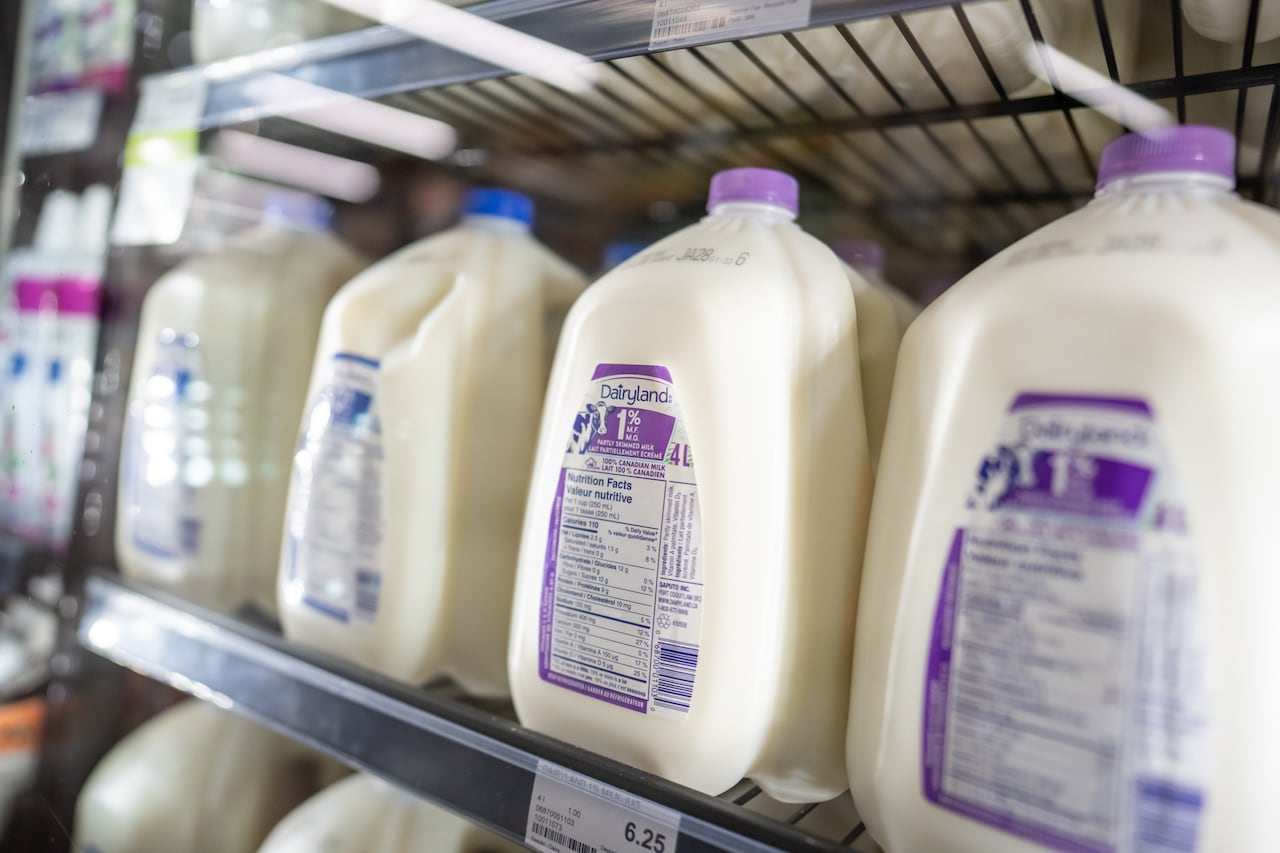
American retailers are prohibited from selling dairy directly in Canada, which is why U.S. milk is not found in grocery stores. (Ben Nelms/CBC)
The U.S. trade deficit with Canada
Trump frequently focuses on trade deficits, viewing them as a sign of weakness.
The White House states, “Canada has generated a persistent average annual goods trade deficit of around $50 billion from the U.S. over the last decade — all while refusing to provide reciprocal access.”
The overall figure is accurate (it was $48.5 billion in 2025, according to the U.S. Trade Representative). However, as premiers and others have pointed out, this is primarily because Canada exported 3.9 million barrels of oil per day to the U.S. last year.
States along Canada’s border require this oil, and it is sold at below-market prices, presenting a significant economic benefit for the U.S.
If the oil were excluded from the calculation, the U.S. would actually have a goods surplus with Canada. In other words, when excluding energy, the U.S. exports more goods to Canada than Canada exports to the U.S.
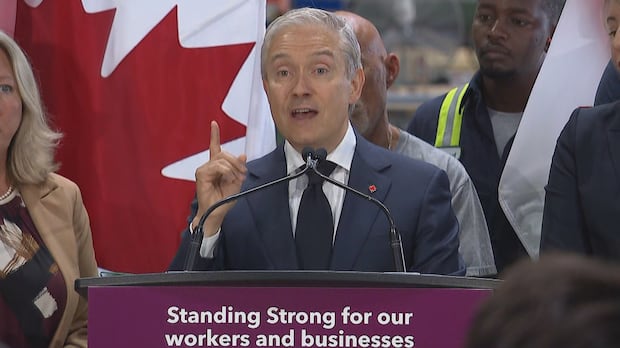
Finance Minister François-Philippe Champagne states that Canada will respond proportionately and strategically to the latest round of U.S. tariffs, which will impact over $27 billion in U.S. goods, emphasizing that the tariffs are focused on fairness.
Certain White House statements are unverified
The statement features a collection of “facts” that are, in fact, opinions or assertions that are debatable.
For instance, it claims: “Without the United States, Canada could not survive. Canada sends approximately three-quarters of its goods exports to America.” While this figure is accurate, and although Canadian officials acknowledge the significance of the U.S. market, the notion of Canada’s survival without the U.S. is a hypothetical scenario that is not being seriously considered.
The statement also asserts: “Canada’s unsuccessful trade policies are pushing its manufacturers southward. A recent survey revealed that 42% of Canadian manufacturers have relocated or plan to move production to the U.S.”
The survey conducted by KPMG indicates that companies are relocating or intending to relocate “due to economic uncertainty and trade and tariff threats,” rather than due to “Canada’s failed trade policies.”
The White House statement concludes with the assertion that the U.S. “holds the clear advantage” due to its significantly larger economy. While no one contests the size disparity, the discussion on who possesses the upper hand in this trade conflict remains unresolved.
- Do you support Canada’s newly implemented retaliatory tariffs on the U.S., scheduled for September 8? Click “Join the Conversation” below. If you’re on the app, tap here.