

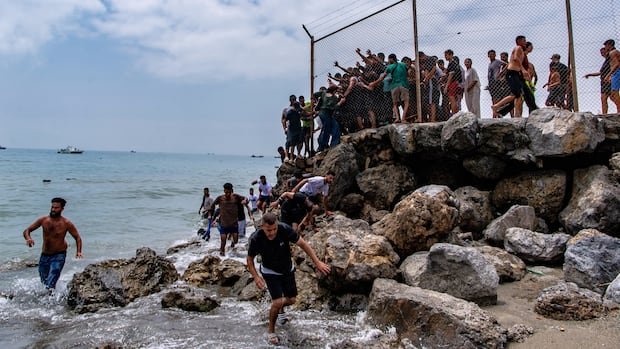

Spanish authorities have characterized the recent events in Ceuta as chaotic, unsustainable, and a violation. Over 57 individuals lost their lives as tens of thousands of migrants breached the Moroccan border into Spain’s Ceuta enclave via land and sea, causing shock and division across Europe.
Estimates suggest that approximately 60,000 people crossed into the Spanish enclave in North Africa on Thursday, with around 48,300 returning to Morocco by Friday evening. Many migrants arrived by sea, either swimming from the Moroccan town of Fnideq, a five-kilometer distance, or attempting to cross from the nearby town of Belyounech, which is a shorter route.
Some individuals who crossed appeared to be children and unaccompanied minors, prompting a warning from a Moroccan NGO about the dangers of taking children on irregular migration journeys.
Spanish authorities confirmed the recovery of 57 bodies on the Spanish side of the border, with potential additional casualties on the Moroccan side. The fatalities included individuals who drowned or were crushed while attempting to climb the breakwater holding the border fence.
Ceuta and Melilla, Spanish territories located on the northern shores of the Mediterranean coast in Africa, serve as key points for migrants seeking better economic opportunities or fleeing violence in their home countries. The territories are heavily fortified and experience periodic surges in attempted crossings by migrants.
The recent rush for the border was linked to a Spanish Supreme Court decision that ruled against the summary deportation of migrants arriving by sea. Spanish Prime Minister Pedro Sánchez attributed the surge to human smugglers. Reports indicated that the ruling spread through social media, encouraging people to attempt to enter Spain, including by swimming to Ceuta.
The response to the influx involved Spain deploying armed forces and additional police to restore order in Ceuta, with efforts to expel those who entered illegally swiftly. On the Moroccan side, security forces used batons and tear gas to prevent further crossings into Ceuta and Melilla.
As the situation unfolded, thousands of migrants found themselves stranded in Ceuta, with reports of returnees facing challenges such as lack of food and shelter. Despite some migrants attempting to re-enter Ceuta, many were deterred by the conditions they encountered.
The sudden surge in migrant crossings reflects deeper underlying issues in Morocco, including economic hardships and limited opportunities for young people. Calm seas and potential political factors may have contributed to the timing of the mass border breach.
Overall, the events in Ceuta serve as a significant test of power dynamics in the region, highlighting the complex challenges faced by migrants and authorities alike.