

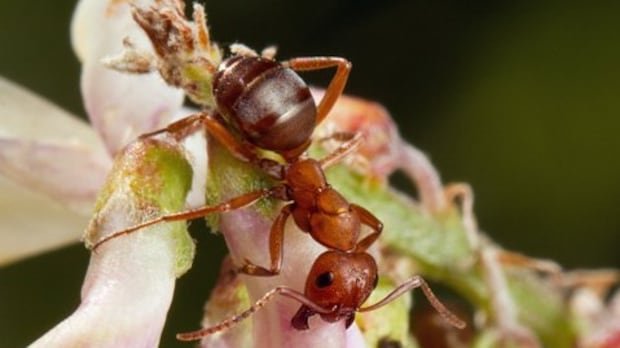

In Alberta’s southeast corner, the Cypress Hills emerge dramatically from the flat prairies. Below the hills in Cypress Hills Provincial Park, a peculiar drama unfolds as ants cling to vegetation, awaiting ingestion by unwitting herbivores. This involuntary act is orchestrated by the parasitic worm Dicrocoelium dendriticum, known for its unique ability to manipulate its host’s behavior.
Researchers from the University of Calgary and University of Lethbridge have identified this parasite as exceptional in the realm of manipulative parasites due to its ability to switch control on and off, a rare phenomenon in the world of parasitic zombies.
Zombie parasites are prevalent in nature, with various hosts being manipulated by parasites to facilitate their transmission to the next host. For instance, the Cordyceps fungus, popularized in media like “The Last of Us,” compels ants to climb plants and die, enabling the fungus to spread its spores. Similarly, the horsehair worm drives crickets to drown themselves, aiding the worm’s reproduction.
Unlike many parasitic relationships that end in the host’s death, Dicrocoelium’s complex life cycle necessitates keeping the host alive. The parasite’s life cycle involves multiple hosts, starting with snails consuming worm eggs excreted by grazing mammals like elk or deer. The larvae develop in snails, are ingested by ants, and manipulate the ant’s behavior to be consumed by the final host.
The challenge for Dicrocoelium lies in ensuring ants are consumed by grazing mammals, which typically avoid consuming ants. The parasite uses a brainworm to compel ants to climb plants where they are more likely to be ingested accidentally.
This strategy poses risks to the ants, leaving them vulnerable to predators and dehydration. To mitigate these risks, the parasite employs an “on-off switch” mechanism that compels ants to detach from plants and return to the nest when necessary.
Researchers are intrigued by the parasite’s ability to adjust its mind control based on external factors like temperature. By studying the genes expressed during this behavior, scientists aim to unravel the mechanisms behind this sophisticated manipulation.
The parasite’s influence extends to biochemical pathways related to stress, feeding, and circadian rhythms within the ant’s brain. This intricate control highlights the parasite’s adaptation to exploit existing neural systems for its benefit.
Despite the complexity of these manipulations, researchers are optimistic about uncovering the chemical cues driving such behavior. Understanding these mechanisms can offer insights into how organisms adapt and manipulate their hosts, shedding light on emerging diseases and human-nature interactions.
The case of Dicrocoelium in Cypress Hills serves as a microcosm of human-induced environmental changes facilitating the spread of parasites. Through inadvertent introductions and landscape alterations, humans have inadvertently created conditions ideal for parasites like Dicrocoelium to thrive, emphasizing the interconnectedness between human activities and ecosystem health.