

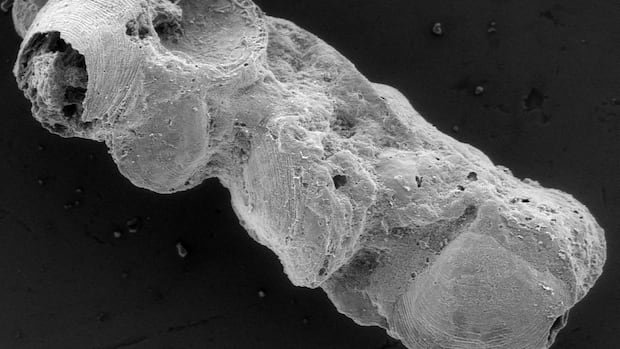

Long before the existence of dinosaurs, a burst of biodiversity led to the rise of early ancestors to present-day animals, accompanied by a surge in excrement. While not the most popular aspect of paleontology, a recent study sheds light on how the examination of coprolites, or fossilized feces, aids in comprehending the ancient ecosystems of Earth, nutrient cycles, and current animal relationships.
The study, recently published in the journal Trends in Evolution & Ecology, delved into the analysis of fecal fossils dating back to the Cambrian period, which commenced approximately 540 million years ago. By scrutinizing feces traces from primitive worms, invertebrates, and mollusk-like creatures, researchers concluded that excrement likely played a role in enhancing the habitability of deep-water ecosystems and increasing nutrient availability during that era, about 300 million years prior to the era of dinosaurs.
The discovery that feces were abundant during the Cambrian period holds significant implications for unraveling the origins of contemporary ocean ecosystems. Julien Kimmig, one of the paper’s co-authors and the head of the paleontology division at the Karlsruhe Natural History Museum in Germany, emphasized the importance of recognizing the substantial role of feces in sustaining both past and modern marine ecosystems.
The research conducted by Kimmig and Russell Bicknell involved the examination of hundreds of coprolites from 37 global deposits, including specimens collected over the years and those housed in museum collections. These fecal remnants originated from various burrowing worms, arthropods, brachiopods, and hyoliths resembling cone-shaped mussels. Initially microscopic, the earliest fecal fossils gradually increased in size over the Cambrian period, eventually becoming visible to the naked eye and containing remnants of shells or worms.
Aside from shedding light on evolutionary patterns and predator-prey interactions, studying coprolites aids in comprehending Earth’s ecology and the transformative effects of the Cambrian Radiation, a period marked by the rapid emergence of modern animal groups in the fossil record, commonly known as the Cambrian Explosion.
Kimmig emphasized the relevance of ecology in paleontology, underscoring how past ecosystems adapted to environmental changes in temperature, oxygen levels, and nutrient availability. By drawing parallels between ancient ecosystems and contemporary ones, researchers can potentially predict future ecological scenarios.
In the realm of paleontology, the investigation of feces presents a new dimension to understanding the enigmatic Cambrian period. Preceding the Cambrian era, the Ediacaran period introduced fossils of considerable size, albeit with organisms vastly distinct from present-day marine life forms.
The Cambrian Radiation, occurring around 520 to 540 million years ago, yielded fossil records of species related to modern animals such as shrimp and marine mollusks, signifying a surge in biological diversity. Understanding this pivotal era is crucial for tracing the origins of today’s oceans, making the Cambrian period a focal point for comprehending evolutionary processes.
The study highlighted a substantial increase in fecal matter during the Cambrian Radiation compared to the preceding Ediacaran period. While much attention is typically directed towards predator-prey dynamics and evolutionary trends of the Cambrian era, analyzing waste products, nutrient cycles, and their impact on biological diversity offers insights into broader ecological and geological aspects, which in turn inform our understanding of present and future ecosystems.
For some paleontologists, coprolites have assumed a central role in their research endeavors. Karen Chin, a prominent figure in the field, initially intrigued by fossilized feces during her graduate studies, now emphasizes the overlooked significance of coprolites. Chin’s research spans the Mesozoic era, characterized by the dominance of dinosaurs, where coprolites provide invaluable insights into ancient food webs and carbon cycles.
Coprolites, despite their challenges and the lack of glamour associated with dinosaur bones, offer unique perspectives on ancient ecosystems and behaviors of prehistoric organisms. Through coprolite studies, researchers can unravel mysteries of the past, such as dietary preferences of extinct species, shedding light on the intricate ecological relationships that shaped ancient environments.
The exploration of coprolites presents a gateway to unlocking hidden narratives of the past and offers a deeper understanding of ancient life forms and ecosystems, fostering a holistic view of Earth’s evolutionary history.