

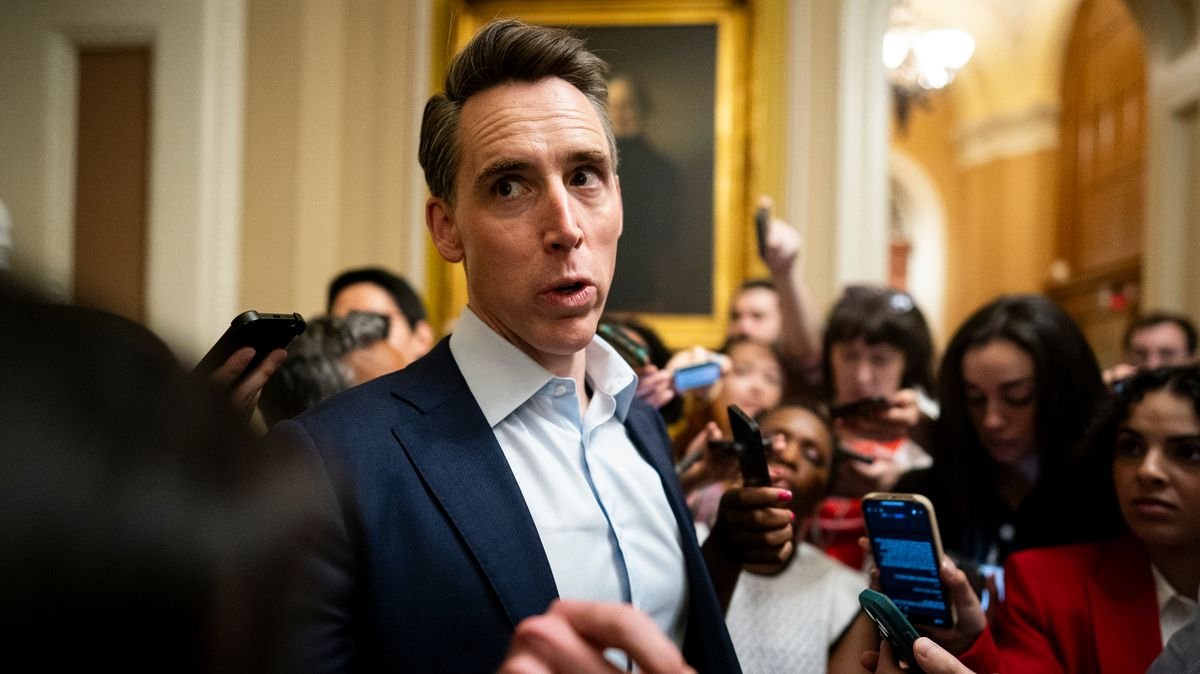

Republicans are pushing back against the rise of artificial intelligence, with a GOP senator cautioning his party about the potential impacts of the technology as it stands at a critical juncture for its future.
Senator Josh Hawley (R-Mo.) and several of his peers have set boundaries regarding the advancement and utilization of AI in recent times. Hawley specifically emphasized AI’s effects on the working class in a speech delivered at a Washington think tank.
In an essay on AI penned earlier in the week, Hawley stated, “The Republican Party faces a crucial decision – one that could shape its trajectory for the next fifty years.” He further elaborated on this sentiment in various speeches, including one at a gala hosted by the conservative think tank American Compass.
Florida Governor Ron DeSantis also criticized the Trump administration for trying to preempt state-level regulations on AI, labeling the move as “poor policy” and “even worse politics.”
Prior to this, President Donald Trump’s appointed Attorney General, Todd Blanche, filed a lawsuit against OpenAI. Additionally, multiple prominent GOP candidates, such as current Texas Attorney General Ken Paxton, who is vying for an open U.S. Senate seat, are campaigning on challenging Big Tech once in office.
The Republican resistance towards AI signifies a robust intervention by the influential conservative faction of the party, which is diverging from Trump’s more hands-off approach to AI development. These leaders, aligned with the ideological right akin to Trump, view AI as a pivotal issue for the upcoming years as they strive to secure positions in the midterm elections and maintain their majority in the House and Senate.
They are willing to challenge the GOP’s traditional pro-business stance favoring deregulation policies.
According to a political analysis by POLITICO, a divide has emerged within the Republican party on this matter, potentially impacting the 2028 Republican primary as the party seeks a successor to Trump post his second term.
Candidates in that race will likely need to outline their strategies regarding AI and other technological advancements, particularly given the digital competition between the U.S. and China.
Voters are also expressing concerns about certain technologies and data centers.
Earlier in the month, the White House issued a long-awaited executive order on AI, signaling a significant shift towards regulating Big Tech, which could lead to mandatory scrutiny or federal approval of advanced AI systems.
This move marked a significant departure from the administration’s previous emphasis on competition with China. Former White House AI czar David Sacks described it as endorsing a “let them cook” approach.
The White House might have been compelled to act due to the emergence of Mythos, a model developed by Anthropic with the potential to disrupt the cyber systems of industries and governments.
Nevertheless, Trump’s executive order retained much of his anti-regulation stance. Despite a brief delay in its issuance, Trump emphasized allowing industry innovation to progress unimpeded as a top priority.
The Trump administration has been adamant about enacting a federal preemption law to prevent states from formulating their own AI regulations. However, this effort has not gained traction among the GOP, historically supportive of states’ rights.
Consequently, the president signed an executive order in December threatening to withhold funding from states attempting to regulate AI.
White House spokesperson Liz Huston stated in a POLITICO release that the administration’s policy is geared towards maintaining American AI supremacy over China to safeguard national security and economic leadership.