

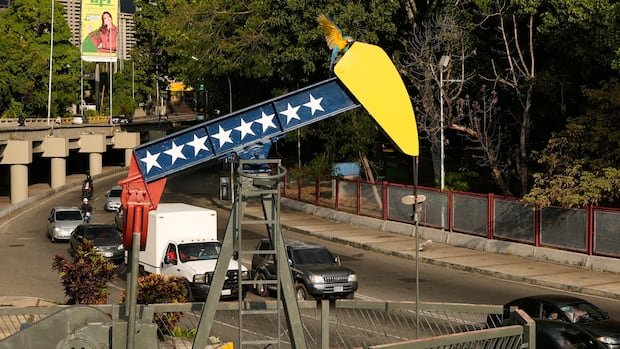

U.S. President Donald Trump has revealed a new agreement aimed at enhancing oil production in Venezuela, emphasizing a potential controlling interest in a segment of Venezuela’s oil reserves as a message to Canada. Despite concerns over increased Venezuelan exports to refineries on the U.S. Gulf Coast challenging Alberta’s oilpatch due to the similarity in heavy oil production, experts believe Western Canada has little to worry about at this time.
Venezuela possesses vast underground oil reserves, but struggles with obstacles to scaling up production, including political instability that could hinder efforts to revive the country’s oil industry. Concurrently, the Canadian oilpatch is achieving record production levels and advancing several pipeline projects to elevate export capacities, with the U.S. continuing to raise its utilization of Canadian oil.
Forecasts suggest a significant surge in Venezuelan oil exports is several years away, alleviating immediate concerns for Canada, according to Grant Sprague, a former deputy energy minister in Alberta. He noted that substantial time and financial investment would be necessary for the U.S. to pursue the deal with Venezuela, indicating limited information is available on the specifics of the agreement.
In a recent announcement, Trump disclosed an agreement with Venezuela granting the U.S. majority control over a fifth of the country’s oil reserves through a direct equity stake in a private company led by a Venezuelan entrepreneur. Trump highlighted the deal as a means to substantially enhance U.S. oil supply and secure control over 65 billion barrels of oil reserves, while Venezuela’s acting president, Delcy Rodríguez, anticipated significant investment inflows while upholding the nation’s ownership and sovereignty over its natural resources.
Al Salazar, an analyst at Enverus in Calgary, noted discrepancies between the messages from Trump and Rodríguez, underscoring uncertainty surrounding the deal’s terms. Canadian oil executives are monitoring the situation but are not overly concerned, preferring to wait for tangible progress in revitalizing Venezuela’s oil industry before reacting.
The Trump administration’s push for American oil and gas firms to invest in Venezuela’s energy sector follows military actions against the country earlier this year, culminating in the capture of then-president Nicolás Maduro. Amidst these developments, the Canadian oilsands industry remains decades ahead, with Northern Alberta serving as the primary source of Canada’s heavy oil production, boasting well-established, cost-effective facilities compared to Venezuela’s struggling oil infrastructure.
Political instability in Venezuela further complicates the potential rebound of its oil industry, with uncertainties surrounding future leadership changes and government transitions. Colin Mang, an economics professor at McMaster University, highlighted the considerable cost and political risks for companies eyeing investments in Venezuela, noting past instances of asset seizures by foreign entities.
Amidst these complexities, a few companies, including Shell and Repsol, have shown interest in potential ventures in Venezuela’s oil and gas sector, with Chevron contemplating expansion. Meanwhile, Canada remains focused on diversifying its oil markets, exploring opportunities in China and India, supported by ongoing pipeline projects like the Trans Mountain expansion and a new federal-provincial partnership initiative.
In conclusion, while the U.S. aims to diversify its oil sources, Canada is strategically expanding its oil export horizons, ensuring a balanced approach in the global oil market landscape.