

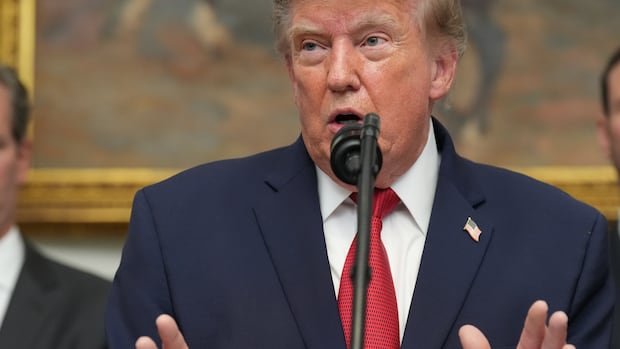

U.S. President Donald Trump took to social media on Wednesday to declare a significant economic campaign against Iran, labeling it as the “MOST CRUSHING ECONOMIC OPERATION EVER TAKEN AGAINST ANY COUNTRY!” Trump emphasized that this operation would involve Economic Warfare and Isolation on an unprecedented level, without providing detailed specifics.
He also cautioned about potential economic repercussions for any nation supporting Tehran or extending any form of assistance to Iran. Trump’s message on social media stated that any country enabling its financial institutions, businesses, airports, or government entities to aid Iran would face substantial Economic Consequences.
While Trump did not outline the specific actions that Washington would take against such countries, he made it clear that activities such as oil smuggling, cash transfers, exchange houses, and front companies supporting Iran needed to cease immediately. He concluded with a stern message, “You know who you are.”
The ongoing conflict in the region has resulted in numerous casualties over the past six months, drawing in nations across the Gulf and causing disruptions in global markets. Iran’s control over shipping routes, particularly through the Strait of Hormuz, a crucial passage for a large portion of the world’s oil trade before February, has added to the tensions.
Despite previous ceasefire agreements between the U.S. and Iran in April and June aimed at restoring normal shipping operations through the Strait of Hormuz, these agreements quickly collapsed. President Trump’s social media declarations, while impactful, do not always materialize as stated.
Recent developments have highlighted conflicting reports regarding U.S.-Iran relations. The United Arab Emirates, a host to a major U.S. military base, announced the suspension of all trade activities with Iran following reports of missile launches from Iran, which Iran refuted as baseless.
China, a significant purchaser of Iran’s oil, poses a challenge for the U.S. in escalating economic actions due to its strategic trade position, including as a major exporter of rare-earth minerals crucial for the U.S. economy.
While an adviser to Iran’s supreme leader expressed openness to dialogue with the U.S., emphasizing that negotiations should not be mistaken for surrender, President Trump denied ongoing talks with Iran. However, Jared Kushner, Trump’s son-in-law and special envoy, suggested that discussions with Iran were still ongoing and possibly more robust than before.