

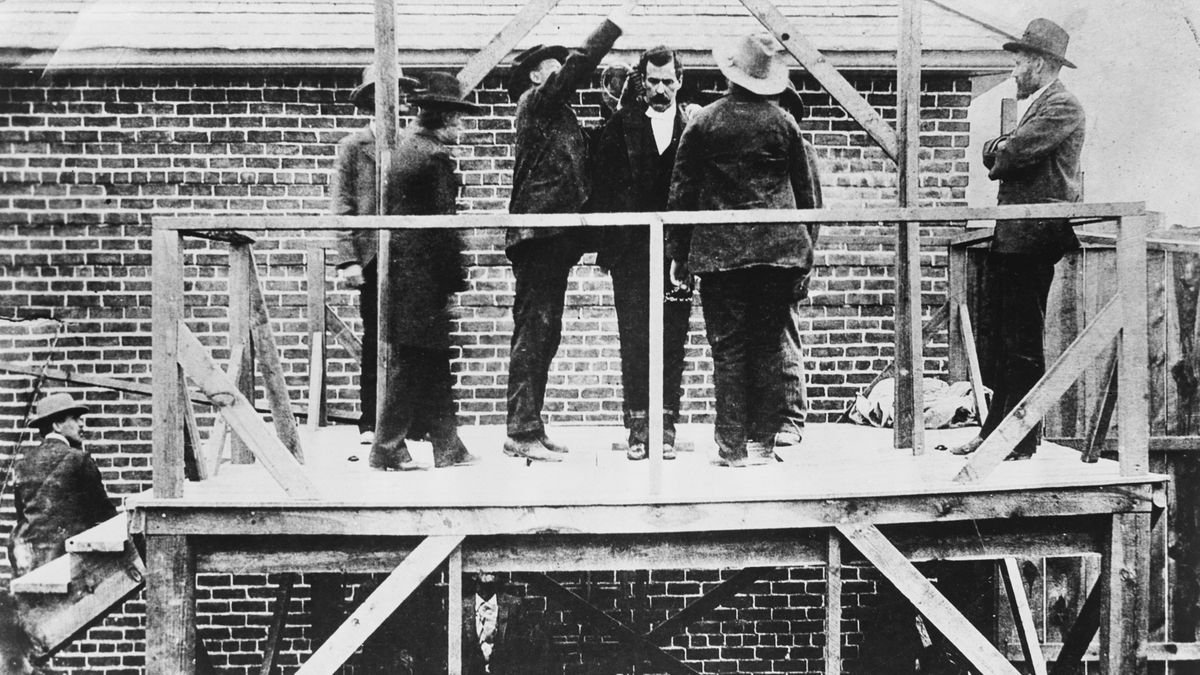

A notorious train robber, Thomas Edward Ketchum, met a tragic end when his hanging resulted in his decapitation and blood spurting from his neck. Ketchum, a member of the infamous ‘Hole-in-the-Wall’ gang from Texas during the late 19th Century, gained attention from law enforcement across multiple states. His criminal career culminated in his capture after a failed train robbery in 1899 near Folsom, New Mexico, where he was severely injured, leading to the amputation of his right arm. Subsequently, he was convicted of attempted train robbery, sentenced to death by hanging, and put on trial in Clayton.
On April 26, 1901, a large crowd gathered in Clayton for Ketchum’s hanging, which was supposed to be a major public event. However, due to a critical mistake by inexperienced executioners who tested the rope with a sandbag, the execution went horribly wrong. The combination of an overlong rope, Ketchum’s weight gain in jail, and the imbalance caused by his amputated arm led to a disastrous execution.
During the hanging, Ketchum’s head was completely severed from his body, with only the hood preventing it from rolling away. The executioners had to sew his head back on for the public burial. The aftermath of the hanging became infamous, with photographs and postcards circulating of the decapitated body. Ketchum’s botched execution remains one of the most extreme examples in US history.
Before his death, Ketchum and his gang, including his brother Sam, attempted a train robbery at Twin Mountain, New Mexico, leading to Sam’s death. Ketchum’s final solo robbery attempt in 1899 also ended in failure, resulting in his arrest and eventual execution. Despite his notoriety, Ketchum’s body was later moved to Clayton Cemetery, where his grave remains a point of interest for visitors intrigued by his macabre story.